
How to Search Criminal Dockets
The Colorado Judicial Branch Docket Search is the free first stop for state cases. It comes prefiltered to El Paso County. Keep in mind that it searches scheduled proceedings, not a complete criminal register of actions. Pick District Court and class CR for a felony. Class M in County Court covers misdemeanors. Class T covers state traffic. JD marks juvenile delinquency, which carries access limits. You must add at least one filter besides the date, and the best search key is a full year, class, and one-to-six-digit sequence.
Confirm the venue with the summons or notice first. Municipal ordinance cases stay with the city clerk and do not automatically appear in Combined Court results. Once a state result appears, read its date, time, hearing type, location, appearance type, and courtroom. Then go to the clerk or an authorized vendor for the longer register of actions. The practical search order is:
- Read the court name and case number on the latest summons, bond paper, notice, or order.
- Choose El Paso County, the right court level, a short date range, and the documented case class.
- Search the full number, or combine a party or attorney name with narrow court and date filters.
- Print or export the calendar result, then compare it with the newest minute entry or hearing notice.
- Request the ROA, charging paper, sentence order, or certified copy from the Combined Court clerk when needed.
El Paso Criminal Docket Classes
Colorado case numbers combine a filing year, a letter class, and a sequence. A District Court felony might appear as 2026CR1234. The letters matter here. The same El Paso County Combined Court runs two state trial-court levels. A felony can even begin with a County Court complaint or advisement. It then receives a District Court CR file after transfer. One case can therefore carry more than one number. It can also carry more than one court-level reference in a set of papers.
- CR
- District Court criminal, chiefly felony matters.
- M
- County Court misdemeanor matters.
- T
- County Court state traffic matters.
- JD
- Juvenile delinquency, with restricted public access.
- Division
- The courtroom or judicial unit assigned to the setting.
A city charge works differently. Colorado Springs, Fountain, Monument, Manitou Springs, and Palmer Lake each keep their own municipal ordinance dockets. For venue, the summons address beats the event location.
El Paso Criminal Felony Transfers
A felony can open in El Paso County Court. It starts with a complaint, an advisement, or a custody setting. It may then move to El Paso County District Court and get a CR case file. Either calendar alone hides part of the path.
Compare every number on the complaint, bond paper, and later notices. Search both court levels when the papers show a transfer. Then ask the Combined Court clerk two things. Which file holds the current ROA? Which division has the next setting? One unified clerk serves both state courts, yet each court level keeps its own jurisdiction and case reference.
What a Criminal Docket Shows
A criminal ROA is a chronological case summary. The official request form calls it a brief explanation that can include charges, sentences, and minute orders. The free calendar is narrower. It shows only the next or recent scheduled event. No charge statute or class, bond terms, plea, counsel, financial history, filed motions, or final disposition appears there. Those limits matter when a result looks complete but is only one setting.
| Case number | Year, class, and sequence, such as 2026CR1234. |
|---|---|
| Court and division | District or County Court, assigned division, location, and courtroom. |
| Calendar fields | Date, time, duration, hearing type, appearance mode, and party name. |
| ROA entries | Charges, sentence or disposition, minute orders, and dated case events when available. |
| Filed documents | Separate items such as the Complaint or Information and Disposition or Sentence Order. |
Order the exact filed document when its wording controls. A calendar label is no substitute for the signed order or charging paper.
El Paso Criminal Calendar Limits
The official public access guide splits free calendar access from charged commercial ROA access and official clerk copies. CoCourts is the authorized paid option. It searches real-time registers of actions by name or number, but vendor results may omit cases, provide no document copies, and are not the official record. The Clerk of Court remains the source. Ask there for an authoritative ROA or certified filing.
| Source | Best use | Main limit |
|---|---|---|
| Free Docket Search | Confirm a scheduled hearing | Calendar fields only |
| Authorized ROA vendor | Search case history by name or number | Charged, may omit cases, no copies |
| Combined Court clerk | Official ROA, filing, or certification | Request and fees may apply |
| Assigned division | Verify a changed setting | Not a full records service |
A blank free result is not the end. First confirm the court and widen the date window. A missing entry can mean there is no hearing in that range, the matter is municipal, the number is old, or the record is restricted. It does not prove the case is sealed.
El Paso Criminal Record Requests
Room S101 is the direct fallback. Go there when a calendar row cannot answer what was charged or how the court ruled. Ask for the ROA to get the chronological summary. Ask separately for the Complaint or Information when the charging text matters, and for the Disposition or Sentence Order when the result and its terms matter.
Include the case number, party name, filing year, case type, and the exact item sought. Email, mail, the statewide form, and the counter all reach the same official record service. Certification is optional. Ask for it only when you need an authenticated copy. The clerk may require identification for suppressed, juvenile, or otherwise protected material.
Colorado Courts E-Filing accepts supported felony, juvenile delinquency, misdemeanor, and traffic filings. But it is a filing and service platform. It is not another public docket viewer. It does not replace the clerk's record service.
Stages on a Criminal Docket
An El Paso County criminal docket tells a story in stages. It usually opens with a Complaint or Information. From there, an advisement names the case and walks through rights and charges. The arraignment entry records the plea stage. Later lines track counsel appearances, pretrial conferences, and motion settings. Many dockets then show a plea or a trial. A sentence order follows if guilt is established, and sometimes probation-revocation or appeal entries appear down the road. Not every case hits every stage. The free calendar also leaves out much of that sequence, so a fuller docket file often shows more.
Docket flow: Filing → Arraignment → Pretrial → Plea or Trial → Disposition → Sentencing
A reset just moves the hearing to a new date. Nothing gets dismissed. When the calendar result and the newest minute order or Notice of Hearing disagree, call the assigned division and ask which one controls.
Note: A hearing type names the event on the schedule. It says nothing about the final result of the charge or the full case history.
El Paso Criminal Division Rules
Local practice shapes what a setting actually demands. Under the Division 22 appearance rules, Webex works for certain represented first appearances, counsel appearances, procedural settings with no guilty plea, preliminary-hearing waivers, service returns, and agreed revocation resets, unless the court says otherwise. Show up in person for unrepresented first appearances. Guilty pleas, contested motions, and preliminary hearings that actually go forward also require your presence. Even so, a virtual label deserves a second look against the current order.
Bonded advisements run in Division DST on Fridays at 10:00. The Division J trailing-docket order governs a calendar where several cases sit in one listed time slot. Appearance must be in person unless Webex approval is granted ahead of time. Watching the livestream is not appearing. After any continuance, the division itself is the best place to confirm whether the time, the format, or the room moved.
Setting check: Calendar → newest ROA or minute entry → assigned division → requested Notice of Hearing.
El Paso Criminal Disposition Terms
El Paso County publishes no official list of local disposition abbreviations. So don't guess at shorthand. Read the written label in context. When the outcome matters, request the sentence or the disposition order itself. A "disposition" is simply the result or status that resolves a charge or case. A "minute order" is a brief official note of court action.
A hearing label is not a disposition code, either. Arraignment, pretrial, setting, and show cause all describe scheduled events. None of them proves a dismissal, a conviction, a plea, or a sentence. The free calendar leaves out an outcome field because of how the system is built, not because of how the case ended.
Which Court Holds Criminal Dockets
El Paso County District Court hears the felonies. Misdemeanors, state traffic, and preliminary felony matters belong to El Paso County Court. Both run through El Paso County Combined Court. They also share one unified clerk at the state judicial complex. Municipal courts keep city ordinance and municipal traffic cases on separate dockets of their own. Juvenile delinquency sits in District Court, with extra confidentiality rules attached.
| Matter | El Paso court | First access point |
|---|---|---|
| Felony | District Court | State hearing calendar, then clerk ROA |
| Misdemeanor | County Court | State hearing calendar, then clerk ROA |
| State traffic | County Court | State calendar or Combined Court clerk |
| City ordinance | Named municipal court | That city court clerk |
Need to know which court actually holds a criminal docket? Read the venue printed on the paperwork first. The El Paso County case search walks through each calendar filter in detail. It covers the fields one by one. Don't assume a local police matter lands in municipal court, since venue can point elsewhere.
El Paso Specialty Criminal Dockets
Several problem-solving dockets operate inside the Fourth Judicial District's regular criminal and family case structures. The official specialty-court hub covers DUI, Veterans Trauma, Recovery, Domestic Violence Court, Family Treatment Drug, Competency, and more. Each case keeps its ordinary case number and the usual access rules.
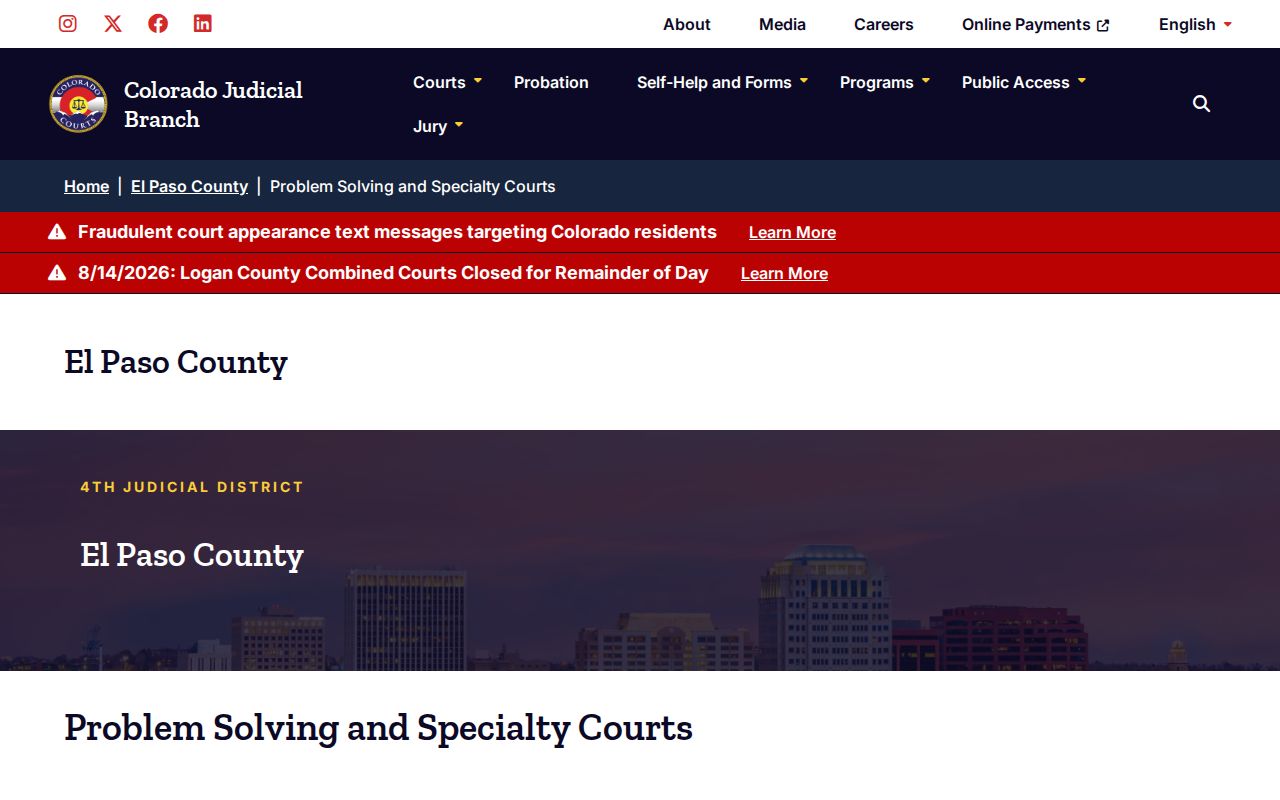
A program list can flag that a specialty docket exists. It cannot tell you an individual hearing date or division. For that, the case ROA and the assigned division govern.
The Recovery Court page traces the program back to a Drug Court founded in 1999. It also explains the current District Court sentencing model.
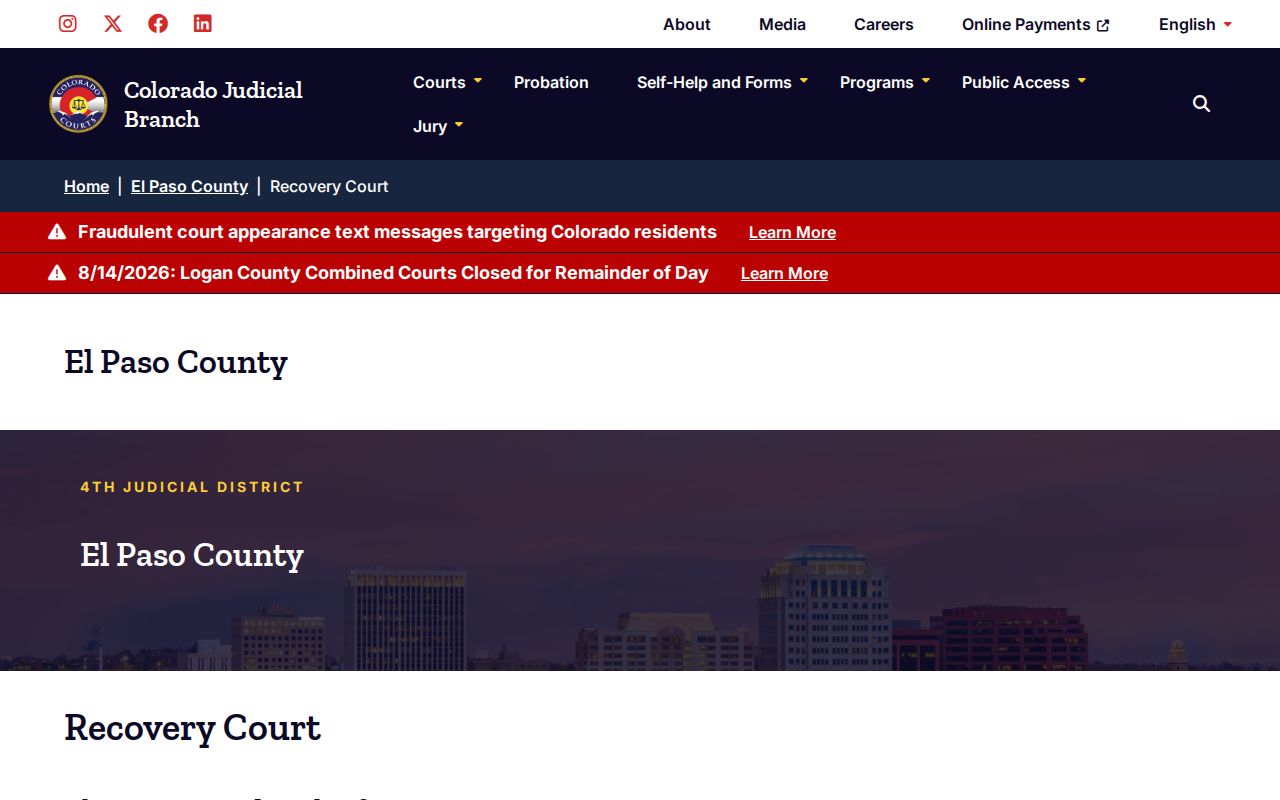
Division L: its review schedule is local calendar context. Eligibility rules and sensitive treatment details may limit what a visitor can observe.
El Paso Criminal Court Milestones
Focused supervision has a long track record here. The Veterans Trauma Court page explains a program that opened in December 2009, making it Colorado’s first court of its kind. It was also one of the earliest veterans courts in the nation to take felony cases.
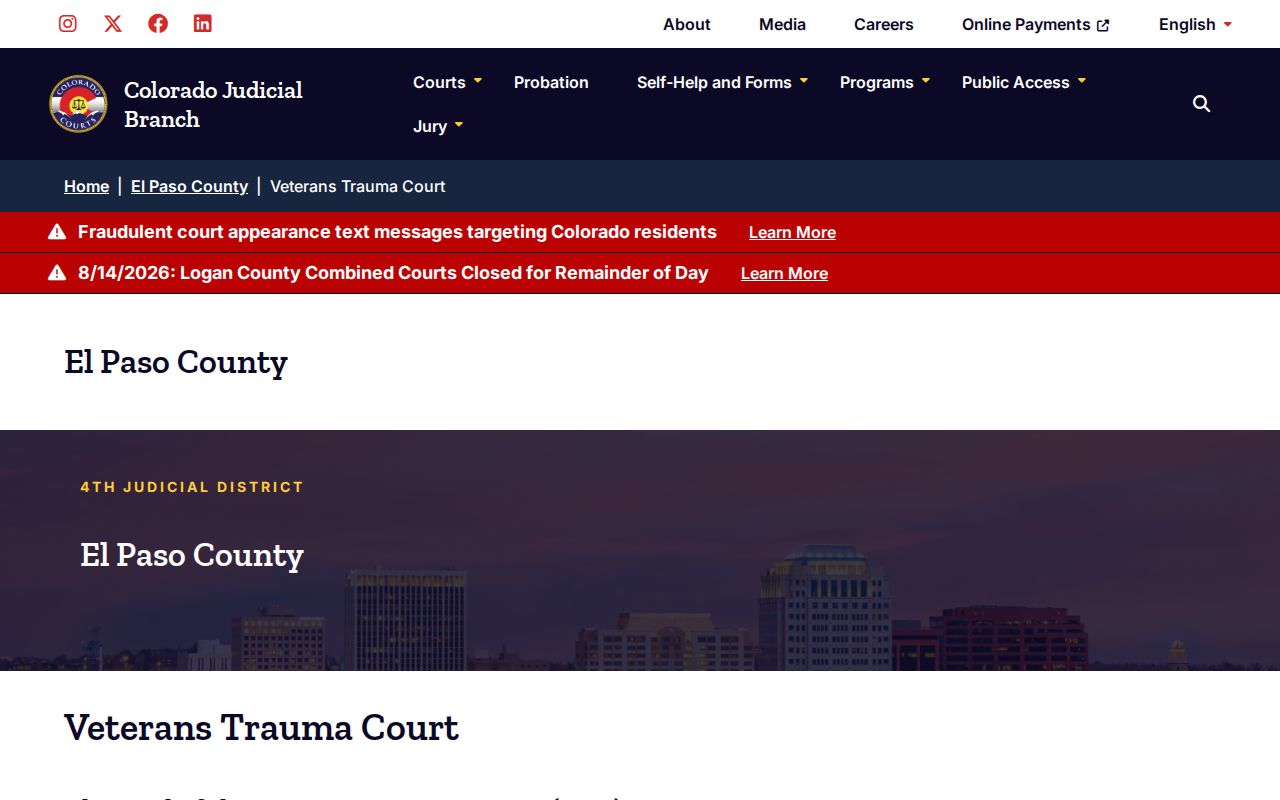
A standard CR case can show up on a named review calendar as a result. That does not create a new public case type. It stays the same El Paso County criminal docket entry. The DUI Court overview lays out a program started in June 2008. Its model runs four phases. There is an 18-month minimum and generally at least two years of probation.
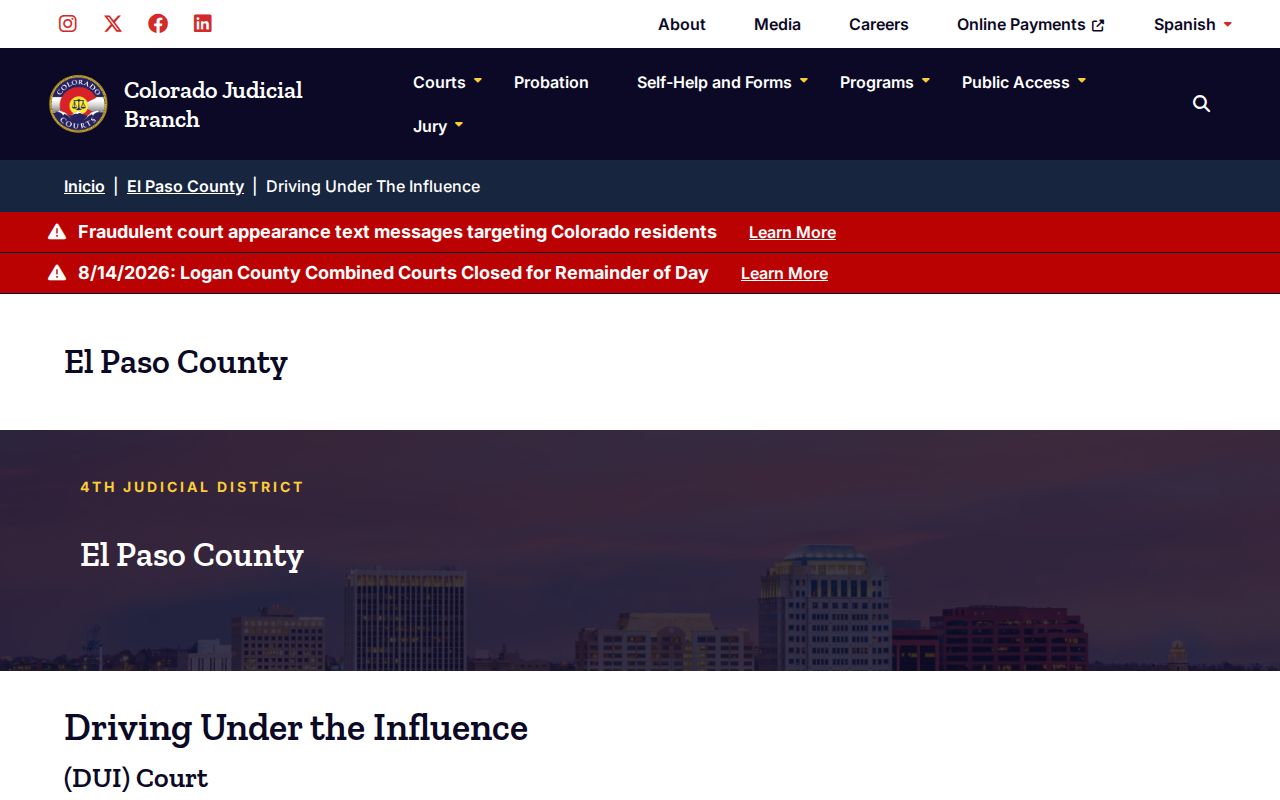
A published program model is useful context for a review setting. It never stands in for the court order, the ROA, or the sentence terms in any specific case.
Public Access and Sealed Criminal Dockets
El Paso County court records are open to look at during normal hours. Online access is a different story. Sealed criminal files stay closed. So do juvenile matters and suppressed records. Identifying data may be redacted. The Sealed Case Search tool works only for a defendant checking automatic conviction sealing under one statute. It skips other sealing routes, municipal cases, and federal matters. Anyone who is not the defendant may get nothing at all.
Want a copy of an official court record? File the state record and document form. You can also email 04ResearchRequest@judicial.state.co.us. Or mail a request to the clerk at 270 S. Tejon Street, Colorado Springs, CO 80903. You can walk up to the counter in Room S101. Call 719-452-5490 with questions about any court docket or filing. Ask by name for an ROA, a Complaint or Information, a Disposition or Sentence Order, or a certified copy.
Key access rules:
CJD 05-01 governs court-facility and remote access, exclusions, redaction, fees, and correction.
CRS 24-72-301 through 305 govern inspection and permitted limits for criminal justice records.
CRS 13-3-117 covers automatic sealing of specified eligible convictions and narrow defendant confirmation.
Bring government photo identification for any local request involving suppressed, juvenile, probate, or protected material. Fees may apply, and certification must come from the clerk. A public El Paso County court docket works well for tracking a case, verifying a hearing, or understanding how the court handled it.