
How to Search the El Paso County Court Docket
Start with the free Colorado Judicial Branch Docket Search. It opens already set to El Paso County hearings. Narrow it by District or County Court, division, date range, case class, party, attorney, or case number. One caution applies. This calendar lists scheduled proceedings only, so it will not show the full register of actions or copies of pleadings and orders.
Your best search key sits in the papers you already hold. Pull out the summons, notice, or last order. Those documents name the court and often the case number too. A city address signals a municipal docket, while 270 South Tejon means El Paso County Combined Court. Keep the date range tight. Then confirm the newest setting before you rely on any date.
- Decide whether the matter is in District Court, County Court, or a municipal court.
- Enter the four-digit year, case class, and sequence when the full case number is known.
- Without a number, combine a party or attorney name with El Paso County and a short date range.
- Read the latest date, time, hearing type, location, courtroom, and appearance mode.
- For case history, obtain the register of actions from an authorized vendor or the clerk.
- Request the named filing, order, or certified copy when the summary is not enough.
The official El Paso County trial-court page shows the local entry points.
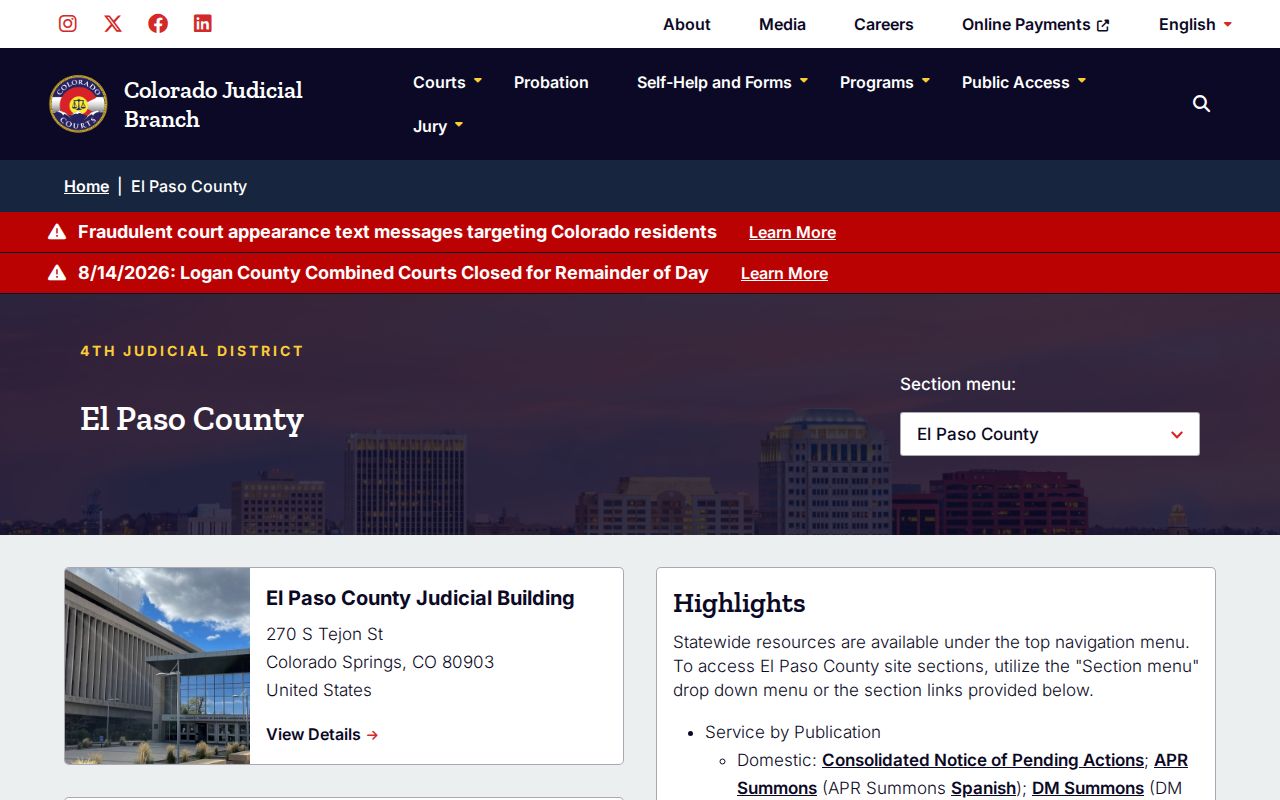
That page connects the county calendar, court forms, judges, and records channels to one combined-court system.
El Paso County Case Number Codes
Colorado state case numbers have three parts: a year, a letter class, and a sequence of one to six digits. The search form wants a four-digit year. Older displays may show only two. Consider 2023CR123456. The CR there marks a criminal class, not a charge code. That letter tells the portal what type of file to hunt for.
- CR
- District Court criminal case, generally including felonies.
- M or T
- County Court misdemeanor or state traffic matter.
- C or CV
- Civil case classes used in the state trial courts.
- DR or PR
- Domestic-relations or probate matter in District Court.
- S
- Small-claims case in County Court.
A class letter narrows a docket search. It cannot prove the free result reflects the whole file. The match is still only a calendar entry. City summons? Use that city's court channel first.
What a Court Docket Shows
Colorado calls the short chronological case summary the “Register of Action” or “Register of Actions.” Per the official request form, an ROA may include charges, sentences, and minute orders. A hearing docket does less. It tells you what is scheduled and where. It does not unfold the full chain of filings behind it.
| Case number | Year, class, and sequence that identify the file. |
|---|---|
| Court and division | District or County Court plus the assigned judicial unit. |
| Parties or caption | The formal names and roles used in the case. |
| Chronology | ROA entries for events, minute orders, settings, and case action. |
| Hearing setting | Date, time, duration, type, location, courtroom, and appearance mode when published. |
| Disposition | The result or status resolving a charge or case when included in the ROA. |
| Filed document | A separate pleading or order that must be requested when no image is public. |
Keep the split in mind. The calendar answers when, the ROA summarizes what happened, and the filed document holds the actual text.
El Paso County Docket Access Layers
El Paso County docket access runs through three state-court layers. The Judicial Branch calendar is free and lists hearings. CoCourts is an authorized charged vendor. It searches real-time ROAs by name or case number, though vendor data can omit cases, gives no document copies, and is not the official record. Need authoritative ROAs, filed documents, or certified copies? The Clerk of Court, El Paso County Combined Court / Fourth Judicial District, is the source.
A fourth system, Colorado Courts E-Filing, handles filings and service for covered case types. It is no unrestricted public docket viewer. The official CCE page spells out that filing role.
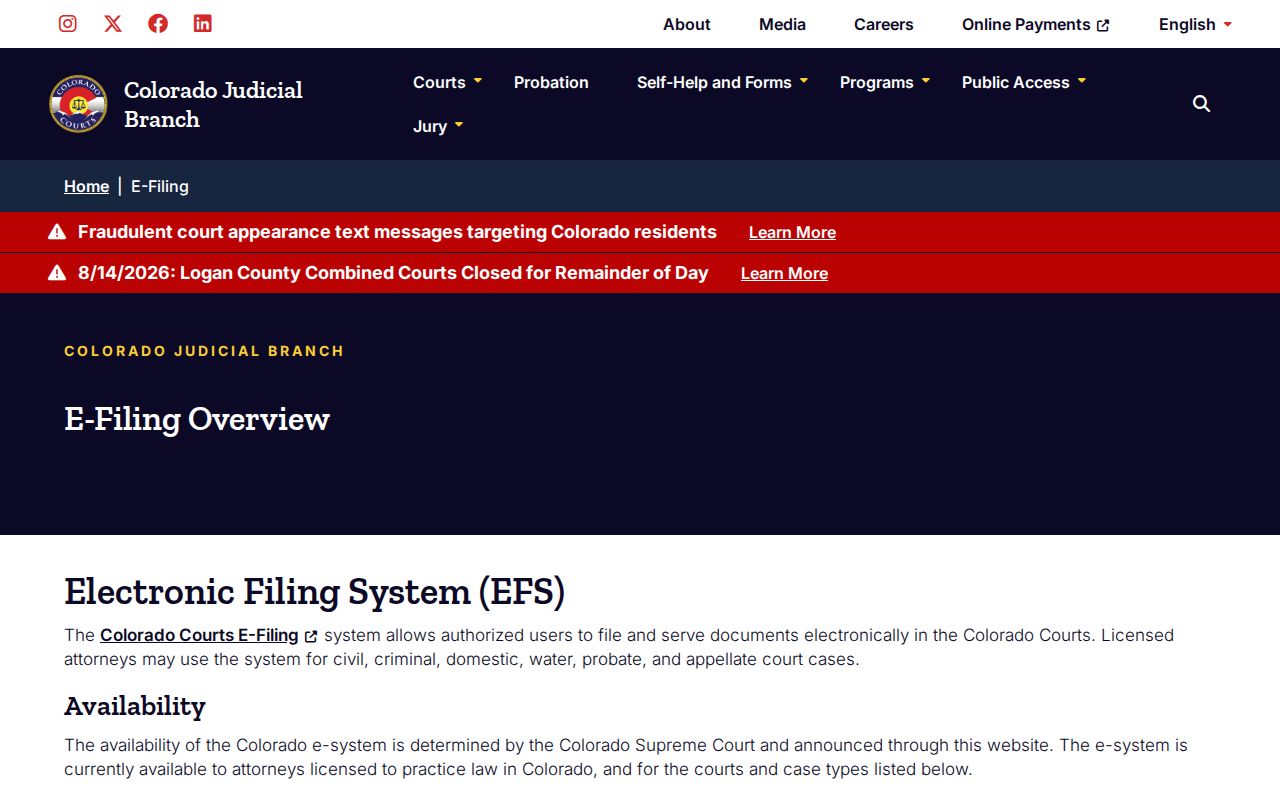
The screen shows how material enters the court, not a public route into every case file.
Which Courts Keep Dockets
Two state trial-court levels share one clerk at El Paso County Combined Court. District Court holds general jurisdiction. County Court covers limited civil, lower-level criminal, state traffic, and several quick-moving case types. Municipal courts sit outside that state channel entirely. They keep their own ordinance dockets.
| Court | Docket covers | Where to search |
|---|---|---|
| El Paso County District Court | Felony, unlimited civil, domestic, juvenile, probate, and mental-health matters | State hearing calendar, authorized ROA vendor, or combined-court clerk |
| El Paso County Court | Misdemeanor, state traffic, preliminary felony matters, protection orders, civil under $25,000, eviction, and small claims to $7,500 | State hearing calendar, authorized ROA vendor, or combined-court clerk |
| Municipal courts | City or town ordinance and municipal traffic cases | Each municipal clerk, local calendar, or local violation portal |
| Federal courts | Federal civil, criminal, bankruptcy, and appellate matters | PACER or the appropriate federal clerk |
The Colorado County Court overview depicts the limited-jurisdiction layer.
This level is often the right stop for state traffic, misdemeanor, small-claims, and eviction settings.
El Paso County District Dockets
A felony may begin as a County Court complaint and advisement. Only then does it land in a District Court CR file. Civil claims split too: District Court hears claims in any amount, while County Court takes those below $25,000. Domestic relations, probate, and juvenile cases belong to District Court. Public access there can be narrower, though. The Colorado District Court overview places El Paso and Teller Counties in the Fourth Judicial District.
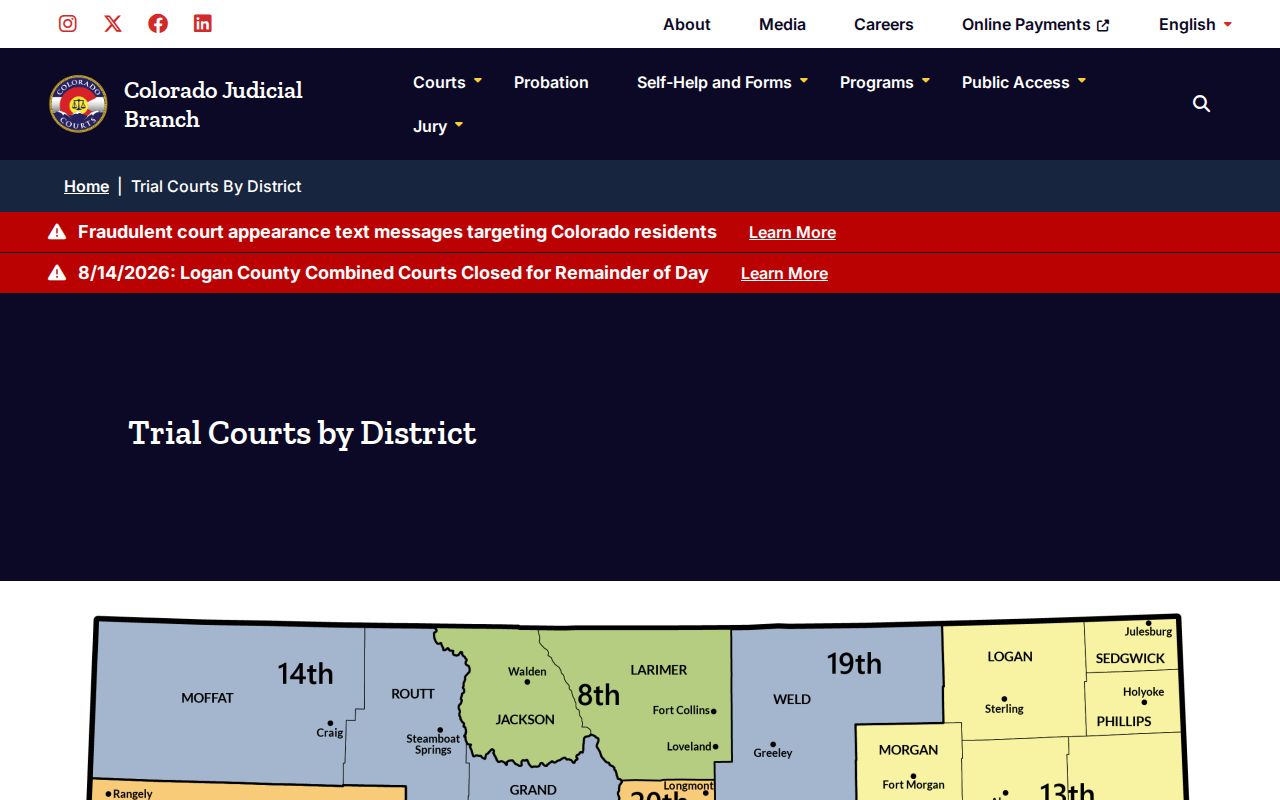
That shared district explains a quirk. Local caseload figures can cover both counties even when the docket search is narrowed to El Paso County.
Finding Court Dates and Settings
Confirm dates in a chain: calendar first, then the newest ROA or minute entry, then the assigned division, and finally the clerk or the actual Notice of Hearing. A reset can leave an older calendar reference behind. The first date you find may not control. Expect the free result to display Date, Time, Duration, Name, Case Number, Hearing Type, Location, Appearance Type, and Courtroom. Export and printable views exist. No document download is promised.
Appearance labels cover in person, telephone, and virtual. Watching a livestream is not a legal appearance, and a Webex link does not grant leave to appear remotely. Division rules control. The full local workflow sits in the El Paso County court calendar.
Note: After a continuance, call the assigned division and compare the newest order before trusting an older calendar entry.
El Paso County Setting Appointments
A setting appointment is an easy local trap. The filer may get an appointment at least two weeks after filing. That happens in domestic, juvenile, District Civil, and probate matters. That call is just a step to obtain the real hearing date. It is not a court appearance.
The filer uses Notice to Set JDF 1123. The filer then phones the division at the appointment time. Once the division supplies a true date, the filer files Notice of Hearing JDF 1124. Probate relies on JDF 710, 711, and 712. An uncontested or default domestic final order uses FCF 1015. So read the word “setting” in context before treating it as anything firm.
Division J adds a wrinkle of its own. Its trailing criminal docket can stack many cases at the same stated time. In-person attendance is required unless Webex permission is granted in advance.
Public Access to Dockets
Most El Paso County court records stay open for anyone to inspect at reasonable hours. Remote access works differently, and it is the narrower of the two. Sealing, redaction, juvenile confidentiality, system suppression, and direct court orders can each hide part of a docket. A blank result can mean any of those. It can also mean the wrong court was searched. Or the date window held no hearing. Maybe the case sits in a municipal venue, or a vendor simply omitted the entry. So do not treat an empty screen as proof the file does not exist.
Colorado access rules:
CJD 05-01 governs facility and remote access, exclusions, redaction, fees, vendor duties, and corrections.
P.A.I.R.R. Rule 1 governs access to court records, while Rule 2 addresses judicial administrative records.
CRS 24-72-301 through 305 sets Criminal Justice Records Act inspection and denial rules.
CRS 24-72-703 removes sealed records from public access while preserving specified lawful access.
Put a public El Paso County court docket to practical use: track your own case, confirm a hearing date, follow public proceedings, or learn how the local courts operate. For anything the docket leaves unclear, the originating clerk remains the final source.
El Paso County Sealed Dockets
Sealed criminal dockets are closed to the public, plain and simple. Certain courts, justice agencies, and authorized users keep access, but everyone else is shut out. Colorado's online Sealed Case Search sounds broader than it is. It serves the defendant only, one case at a time. It merely confirms automatic eligible-conviction sealing under CRS 13-3-117. Petitions, motions, municipal cases, federal cases, and non-conviction paths all fall outside it.
Juvenile and dependency records carry their own restrictions. Suppressed, probate, and protected documents may demand government photo identification. They may also demand proof of entitlement before the clerk releases anything. One caution: never call a missing case sealed without checking first. Recheck the court, the case number, and the dates. Then ask Room S101.
The Clerk and Docket Records
Clerk Sheri King heads the combined-court clerk's office. The records counter in Room S101 is the place to walk in. You can inspect files there or hand over a request in person. Prefer another way? The clerk also takes docket record requests through the statewide online form. You can send a local PDF by email, use mail, or call with questions. Expect an answer to the online form within three business days. Unusual conditions can slow things down. Any fee you are quoted expires if it goes unpaid for 14 days.
El Paso County Combined Court Records
270 S. Tejon Street, Room S101
Colorado Springs, CO 80903
719-452-5490
04ResearchRequest@judicial.state.co.us
Weekdays 7:30 a.m. to 4:30 p.m.
A precise request speeds everything up. Name the case. Give the filed year, the case type, and the parties. Then state the exact product you want. The statewide form splits out family decrees and parenting plans, criminal complaints and sentence orders, civil judgments and satisfactions, probate papers, the ROA, and certified or exemplified copies. No case number? Give party information, a date of birth when known, and any other identifiers so the clerk can tell the files apart. Restricted material may still require government photo identification and proof that you may inspect it.
| Common clerk product | Current fee |
|---|---|
| Single-sided plain copy | $0.25 per page |
| Double-sided plain copy | $0.50 |
| Certified or exemplified copy | $20 per document |
| Name search | $5 |
| Transcript of Judgment | $25 |
| Certificate of Satisfaction | $20 |
Copy costs depend on who is asking. Party and attorney copies carry a $15 maximum; nonparty copies have no cap. Off-site retrieval is billed at actual cost. Research or redaction beyond the first hour runs $30 per hour, charged in 15-minute increments. Keep these clerk charges separate from filing fees. A vendor ROA search costs something different. The Judicial Building page confirms the courthouse location and its service details.
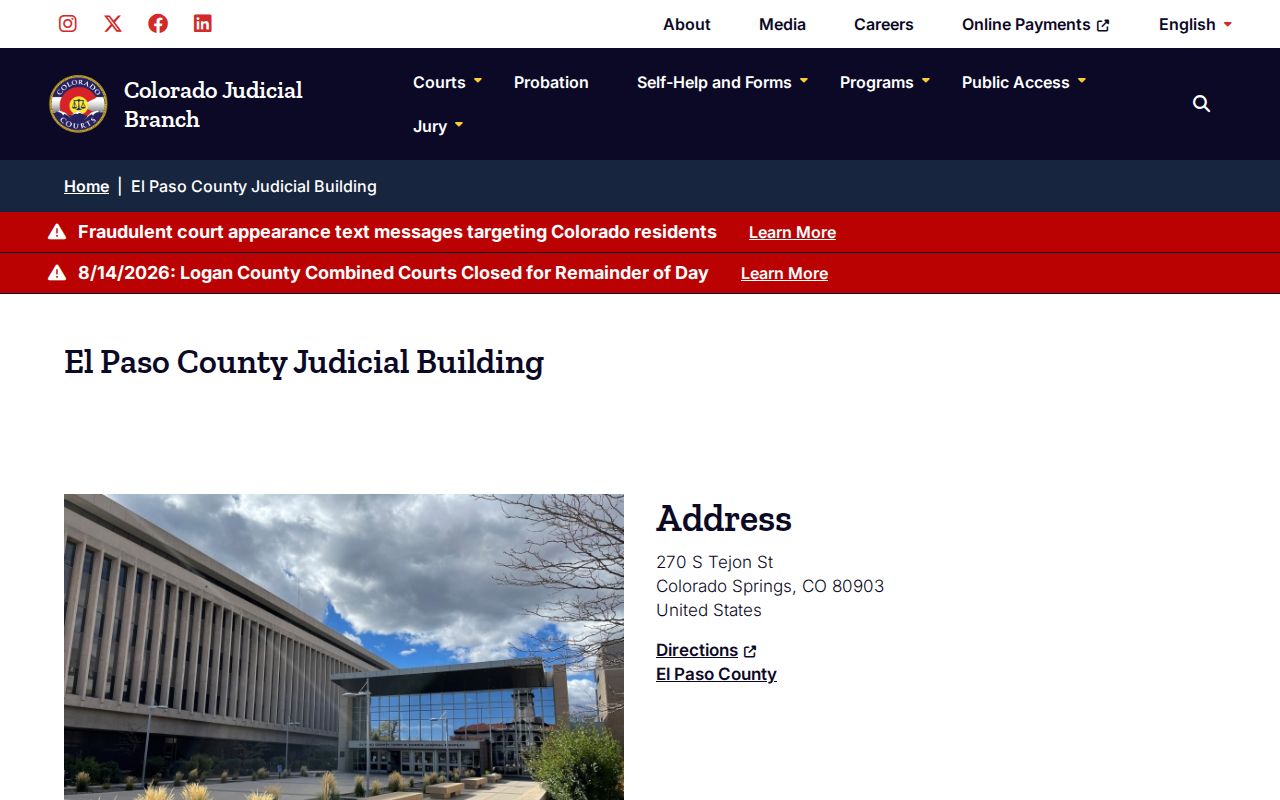
Room S101 closes early, at 3:30 p.m., on each third Wednesday in 2026. If your visit is time-sensitive, check that schedule before you go.
El Paso County Docket Scale
How big is this docket? The Fourth Judicial District FY2023 overview counted more than 73,000 filings. District Court carried 23,078 of them and County Court 50,833. Read those numbers carefully, though. They span El Paso and Teller Counties. They are district-wide, year-specific figures, not a tally of currently searchable El Paso County cases.
That volume explains a practical quirk of docket search. A broad party-name search can slam into the 5,000-result cap. Narrow by county, court type, division, and date. That is more than convenient. Sometimes it is the only way to get a result list at all.
El Paso County Court Technology
Colorado's e-filing rollout came in stages. Civil e-filing arrived in 2013, criminal e-filing in 2017, and non-attorney domestic e-filing in 2019. The Judicial Branch followed with a redesigned accessible website in July 2024. The result is a set of separate tools with separate jobs. CCE handles filing. Docket Search lists scheduled hearings. Vendors sell charged ROAs. The clerk holds the official documents.
Colorado Springs keeps its municipal court records apart from general city records, too. Its CORA page routes municipal requests straight to the court.
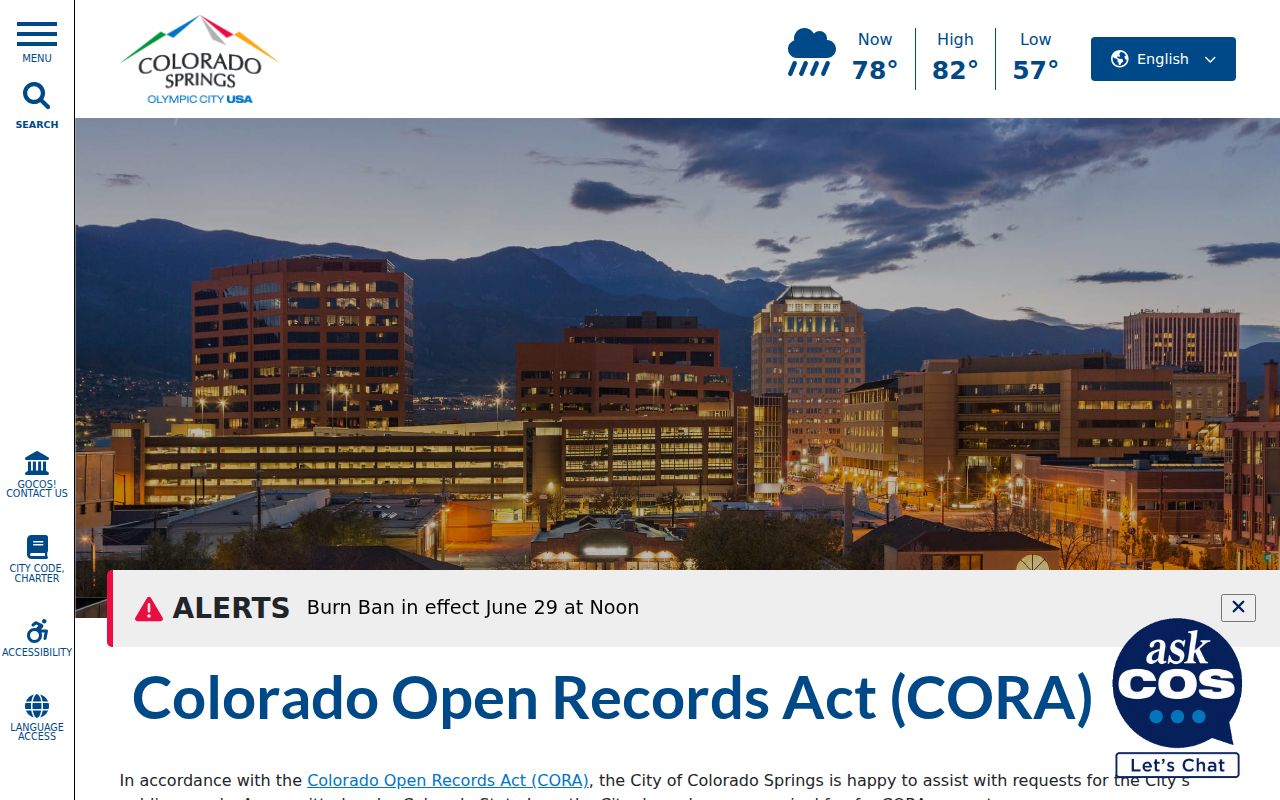
The lesson holds for every search route: a municipal case belongs to the city court, not automatically to the combined-court clerk. Federal cases run on another track entirely. The District of Colorado contact page identifies the Colorado Springs federal courthouse for those matters.
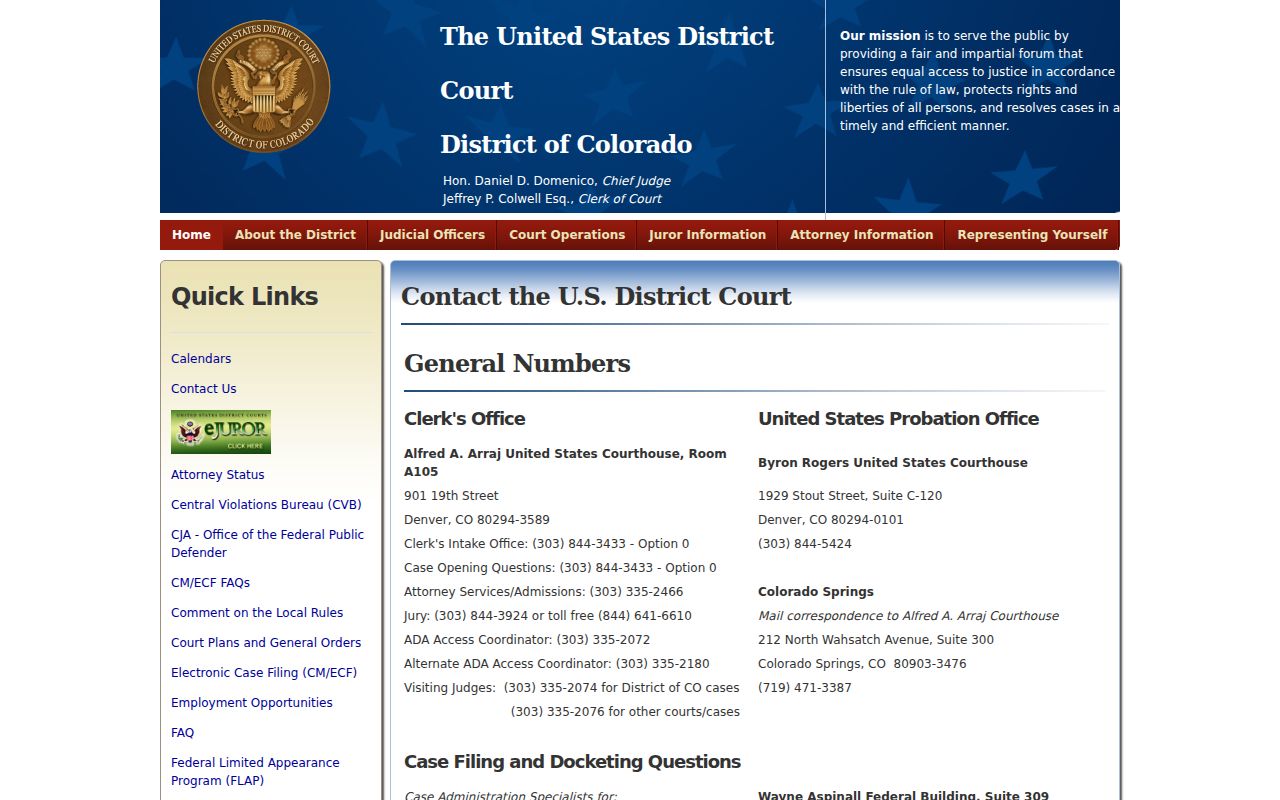
PACER and federal clerks, not the Colorado Judicial Branch calendar, control those dockets.
Court Dockets by City in El Paso County
El Paso County's five largest incorporated municipalities each have a local court path, per the official 2020 Census ranking. Colorado Springs offers clerk records and live courtroom audio but no complete public name docket. Fountain provides a public violation search. Monument puts the clerk first. Manitou Springs posts monthly docket PDFs. Palmer Lake leans on its town calendar and clerk. Larger unincorporated places get no mention here, since they have no municipal court at all.
Colorado Springs Court Docket
478,961 · Robert M. Isaac Municipal Court records and settings
Fountain Court Docket
29,802 · Tyler violation search and municipal clerk
Monument Court Docket
10,399 · Second-Wednesday sessions and clerk-first access
Manitou Springs Court Docket
4,858 · Public monthly calendar PDFs and Memorial Hall clerk
Palmer Lake Court Docket
2,636 · First-Monday sessions and direct clerk confirmation
One rule cuts through the confusion. Follow the issuing agency and appearance address printed on the summons. Do not rely on your guess about venue. A city police citation can still name El Paso County Combined Court. That printed venue controls which docket search route you take.
Map and Directions to the El Paso County Judicial Building
District Court and County Court files for El Paso County are kept at the El Paso County Judicial Building, also called the Terry R. Harris Judicial Complex, at 270 S. Tejon Street in downtown Colorado Springs. The clerk and records counter is Room S101, which also houses Self-Help; probate walk-up service is in W149/W150 on a Wednesday-only schedule. Same-day civil protection-order petitions must be filed by 9:30 a.m. or they carry to the next business day.
El Paso County Judicial Building
270 S. Tejon Street
Colorado Springs, CO 80903
719-452-5000
Weekdays, 8:00 a.m. to 5:00 p.m.
Security screening applies to every entrant and weapons are prohibited. Metered street parking sits a block or two away, and the Colorado Springs garage at 130 S. Nevada is another option; jurors alone get validated parking at 50 E. Costilla or 255 S. Sahwatch, with Costilla the more accessible choice. The ADA coordinator, Bridget Collins, can be reached at 719-452-5000 for accessibility needs.